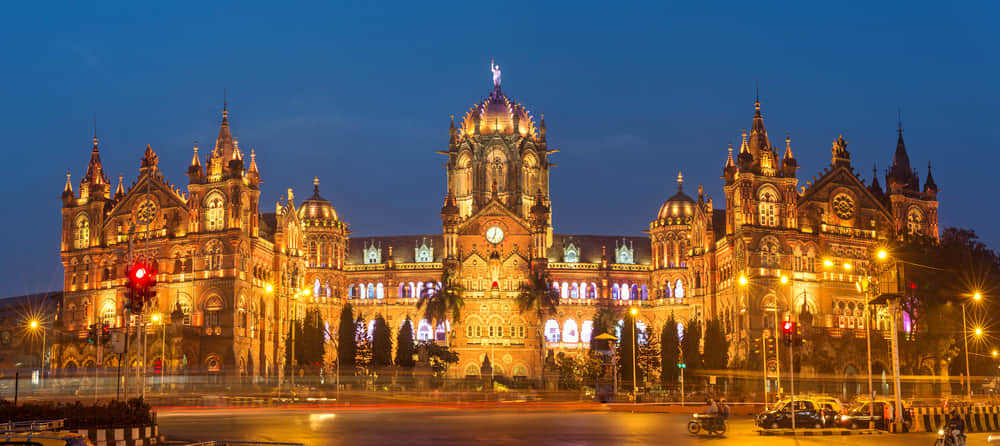
Standing tall on the shore of the Arabian Sea, the Victoria Terminus now called Maharaja Chhatrapati Shivaji Terminus is the first functional railway station of the Indian subcontinent and one of the finest examples of 19th-century railway architecture in the country.
The terminus building was designed by F.W. Stevens exhibiting the strong influence of Victorian Gothic Revival and traditional Indian architecture in its edifice. The construction of Victoria Terminus started in 1878 and it took 10 years for its completion by the British and Indian architects whose main objective was to build something unique on the soil of Mumbai.
Over the years, Victoria Terminus became a commercial hub and an insignia of the economic growth of India. The Maharaja Chhatrapati Shivaji Terminus building spreads over a whopping 2.85 hectares area which is maintained by the Indian Railways.
It is one of the busiest railway stations of Mumbai commuting more than 3 million passengers every day. There is a protected buffer zone covering an area of 90 hectares in the terminus premises. Apart from its initial 4 railway tracks, Victoria Terminus has 7 suburban and 11 out-station tracks to handle the growing traffic over the years.
The property had been declared as Heritage Grade I on April 21, 1997, under the Maharashtra State Government Act resolution and retains the major part of its original architectural integrity even today.









.jpg.jpg?w=1536&q=65&format=auto)