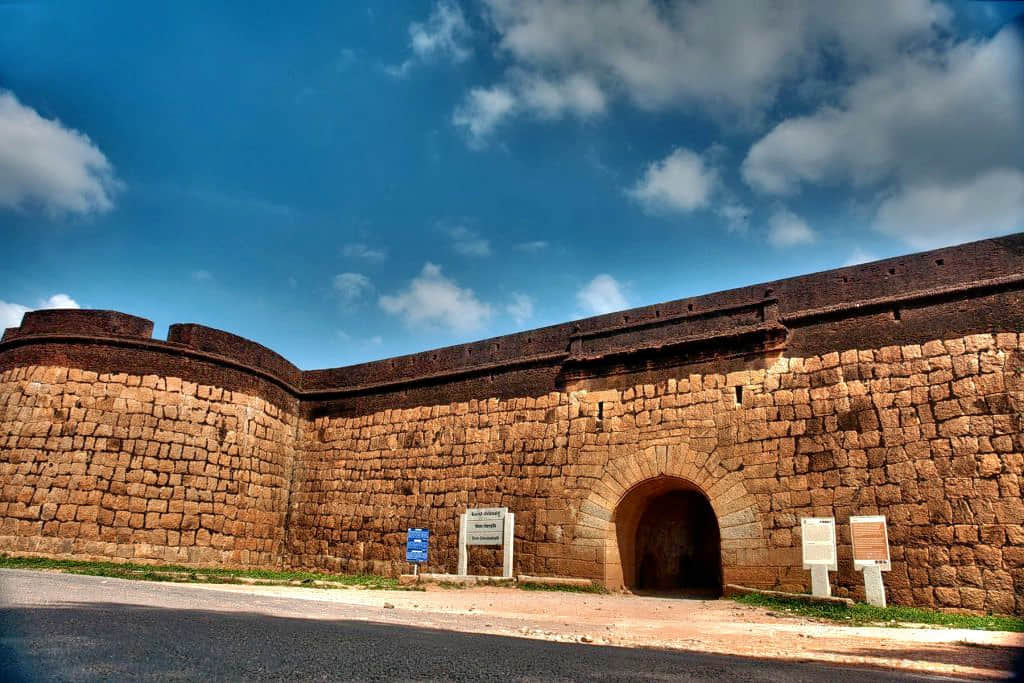
Around 35 km north-east of Bangalore, one will find the fort of Devanahalli. It was built in the first half of the 16th century and is one of the most popular forts for tourists in India . Devanahalli fort is a spectacle among other forts in India because of its architecture and its history of various battles fought..
The Gowda family built the fort and kept it as their home for many decades. One can find the ruins of the age-old houses and some of them are still unshaken till date. Located near Bangalore, the fort has been a place of cultural importance as it was the ground for numerous battles.
Devanahalli fort is among the most architectural forts and also one of the biggest forts in India spanning over an area of 20 acres. Due to its historic importance, it attracts many visitors from India and other countries.
It is located near the birthplace of Tipu Sultan who is also known as ‘the tiger of mysore’. With many temples located inside the fort and the graffiti of the battles fought here reflected through its walls, the fort is an ancient marvel and of its kind.
Talking of the temples in the fort, some temples are dedicated to the local deities. Among them, the prominent ones are Siddheswar Swami temple, Chandramouleshwara temple, and Raghavendra Swamy temple.
During the various battles fought in the fort, there were some minor damages done to the temples. Over some time, the temples were repaired and now are the hub of various tourists from India as well as other countries.
History of Devanahalli Fort:

Rana Baire Gowda, father of Malla Baire Gowda had a dream in which he was directed to build a settlement in Devanahalli. In 1501, Malla Baire Gowda laid the foundation stone of Devanahalli Fort in the Devanahalli village. The Devanahalli Fort remained the home ground for many battles over a period spanning 200-250 years. The fort has many remains and ruins from the historic battles which were fought here.
Malle Byre Gowda and his descendants had the fort under their control for over 2 centuries from 1501 to 1749. Later in 1749, the dalwai of Mysore, Nanjarajaiah conquered the fort and a long history of Gowda family came to an end.
The fort was in possession of Nagarajaiah and soon went into the hands of the sultan leader, Hyder Ali. During this period of years (1749-1790), the fort witnessed several battles and also saw the overcome of new kingdoms in the region.
After Hyder Ali had the fort under his belt, the Devanahalli Fort went into the power of Tipu Sultan. Even the mighty Marathas had the fort under their control for a subsequent period but they could not keep up with the battles they fought against the Sultans.
In 1791, the Britishers under the leadership of Lord Cornwallis overthrew the Sultanate in the Mysore War and captured the fort. The fort was in total control of the Britishers for over 150 years until India gained Independence in 1947.
The architecture of Devanahalli Fort:

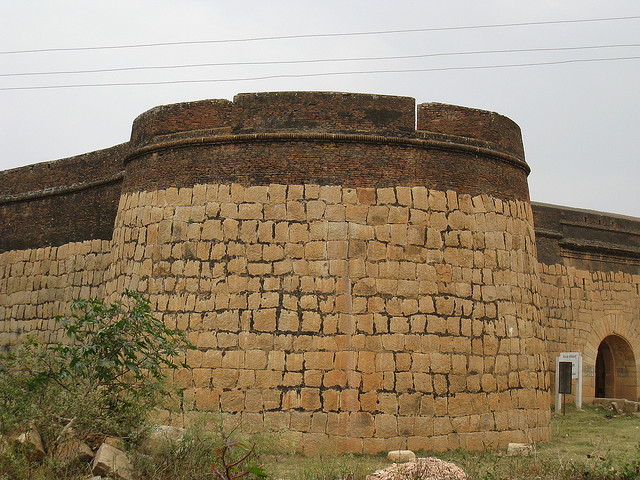
Most of the original fort built in 1501 is damaged now and all that remains now is the various reconstructions it had over a while. The fort went through many modifications in its structure as it was the battleground for over 2 centuries.
The modern-day fort is the result of the changes made by Hyder Ali and later by Tipu Sultan. Since the fort was always in a war type situation, it has around 12-semi circular parapets each having room to hold guns. During the time of battles, these parapets were the base ground for overseeing the enemies and planning in advance the possible moves.
The fort has entrances in the east and west which are relatively small and are designed with cut-plasterwork. Devanahalli fort was the home of Hyder Ali and the birthplace of Tipu Sultan and to date, one can see the remains of their residence.
Among the many giant pillars located in the fort, one can see many enclosed structures that housed Tipu Sultan during the battles. There is a memorial built in the fort in the form of a stone tabloid which has the name “Tipu’s Birthplace” engraved on it. Around the memorial, one can see various plantations of tamarind, mango, and bananas.